Health & Safety Policy — Office Clearance Camden Town
This document sets out the health and safety policy for office clearance operations provided by our rubbish removal and office waste teams. The purpose of this policy is to protect employees, contractors, visitors and third parties during all phases of office clearance, including pre-clearing surveys, removal, transport and disposal. The policy applies to Camden Town office clearance and similar service area engagements where office furniture, equipment and general waste are handled. Compliance with statutory duties and recognised industry standards is mandatory for all staff and sub-contractors.Scope and Objectives
The scope of this policy covers planning, risk assessment, waste segregation, manual handling, use of plant and vehicles, hazardous materials identification, personal protective equipment (PPE), and emergency response for office clearance activities. Key objectives are to eliminate or reduce risks, ensure safe systems of work for office rubbish clearance and minimise environmental impact. All personnel must understand their roles and responsibilities and cooperate to maintain a safe working environment. All office clearance operations shall begin with a documented risk assessment and method statement. These identify hazards specific to the job such as slips/trips, manual handling injuries, electrical risks, asbestos, sharps, and contaminated waste. Control measures include safe lifting techniques, team lifts for heavy items, mechanical aids, defined exclusion zones, secure loading practices and correct segregation for recycling and disposal. The assessments are recorded, reviewed where conditions change, and retained in project records.
Responsibilities are allocated as follows: senior management retains overall accountability for health and safety strategy and resource allocation; line managers implement procedures on site; operatives follow instructions and report hazards; and safety officers periodically audit compliance. Employees must not commence clearance tasks until required PPE, training and equipment are in place. Sub-contractors are required to demonstrate equivalent health and safety standards prior to engagement.

Control Measures and Safe Systems of Work
Operations shall be conducted using documented safe systems of work for all routine and non-routine tasks. Controls include:- Pre-clearance site walkovers and hazard checks;
- Use of appropriate PPE (gloves, hi-vis, safety boots, eye protection and dust masks as necessary);
- Mechanical handling aids (trolleys, pallet trucks, mobile lifting devices) for heavy or bulky items;
- Segregation and labelling of recyclable, non-recyclable and hazardous waste;
- Secure loading/unloading procedures to prevent falling items during transport.
Training and competency are essential: induction for all new starters; task-specific instruction on manual handling, use of plant, COSHH awareness for chemicals and safe manual handling refreshers. Records of training and competency checks are retained and reviewed. Staff are encouraged to contribute to continuous improvement through reporting near-misses and participating in safety briefings.
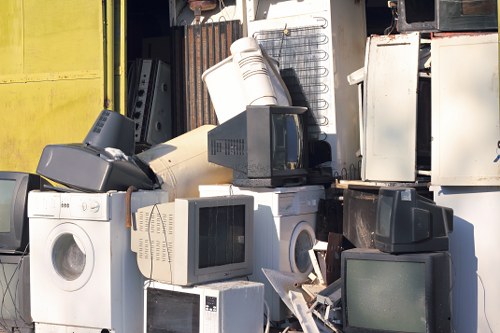 Hazardous materials require particular controls. If asbestos or suspected asbestos-containing materials are encountered during a clearance, operations must cease immediately and a licensed specialist engaged. Electrical items and batteries must be handled and stored separately. Sharps and contaminated items must be segregated and disposed of via authorised clinical or hazardous waste routes. These provisions apply to all office clearance and rubbish collection tasks regardless of site.
 Emergency procedures include arrangements for first aid, incident reporting, fire and spill response. First aid provision is based on an assessment of the workplace and task risks. All incidents, accidents and near-misses must be reported promptly and will be investigated to identify root causes and preventive actions. Records of incidents and subsequent corrective measures are maintained and used to update risk assessments and training.
Monitoring, audit and review cycles ensure ongoing conformity. Regular inspections, toolbox talks and formal audits check adherence to the policy and identify opportunities for improvement. Performance indicators include incident frequency rates, audit findings closed out within defined timescales and staff competency metrics. This policy is reviewed at least annually or whenever legislative changes, significant incidents or operational changes occur.
Compliance with applicable law and industry guidance underpins this policy. Contractors and staff engaged in office clearance operations must act in accordance with legal duties and recognised best practice for rubbish clearance and waste transport. Insurance, licences and permits required for the safe removal and disposal of waste must be current and available for inspection.
Communication is essential: safety briefings are held before work starts, risk controls are clearly communicated on-site, and changes to procedures are cascaded through supervision and documented updates. Employees and sub-contractors are expected to raise concerns without delay and to co-operate fully with any investigations or remedial measures.
Policy approval and application: This health and safety policy is authorised by senior management and applies to all office clearance and office waste removal operations carried out on behalf of the organisation. All personnel are required to familiarise themselves with its contents and adhere strictly to its provisions. Non-compliance is treated seriously and may lead to disciplinary or contractual action. This policy supports a systematic approach to safer, compliant and environmentally responsible office rubbish clearance services.
